The EPN Forum is the flagship biennial event of the Ecumenical Pharmaceutical Network (EPN), bringing together EPN members, healthcare professionals, development partners, policymakers, and other stakeholders committed to strengthening healthcare and pharmaceutical services across Africa.
The Forum provides a platform for learning, knowledge exchange, collaboration, and strategic dialogue on emerging issues in pharmaceutical and health service delivery within faith-based health systems. Participants share experiences, best practices, innovations, and practical solutions while contributing to discussions that shape the future direction of the Network.
Beyond the technical sessions, the Forum offers valuable opportunities for fellowship, networking, and partnership building. Each edition focuses on a timely healthcare or pharmaceutical theme and is typically preceded by specialized pre-conference events and concluded by the EPN Annual General Meeting (AGM).
Since its inception, the EPN Forum has grown into a leading platform for faith-based healthcare and pharmaceutical stakeholders across Africa.
2024
2022
2018
2016
2014
2012
2010
2008
2006
Theme: Sustainable and Resilient Health Systems for Last-Mile Access in Africa
Date: 5th – 9th October 2026
Co-Hosted by: Churches Health Association of Zambia (CHAZ) & Pharmaceutical Systems Africa (Pharma Connect Africa)
Venue: Lusaka, Zambia
The 9th edition aims at providing a platform for key stakeholders and members to address the systemic challenges that hinder access to healthcare through knowledge exchange and sharing of best practices as well as lay a foundation for collaborative action in prioritizing the needs of the most vulnerable populations.
This will ensure strengthened health systems that are resilient, equitable and efficient as well as advancing the principle of leaving no one behind.
The forum will constitute:
a)APre-Conference
A closed two-day Policy Dialogue and Lobbying Think-Tank Workshop, bringing together selected CHA and DSO Chief Executive Officers alongside advocacy experts. The workshop will equip participants with practical tools for active engagement in national health governance, focusing on budget mapping, stakeholder power analysis, and advocacy strategies to ensure that faith-based health systems are fully integrated into national UHC frameworks and government financing mechanisms.
b)Main conference
The main conference will convene policymakers, regulators, faith-based health leaders, EPN members, pharmaceutical manufacturers, and development
partners to explore practical strategies for strengthening sustainable and resilient health systems. Sessions will include high-level plenaries, thematic breakout discussions (World Café format), expert panels, and poster presentations. The conference will also feature the formal launch of key EPN documents including the 2026–2030 Strategic Plan, and a Call to Action on Sustaining the Last Mile.
c)Annual General Assembly
The EPN Annual General Assembly is reserved exclusively for EPN member organizations. The AGM will review institutional performance, approve financial statements, adopt key resolutions aligned with Forum outcomes, and set the governance direction for the coming biennium
FORUM OBJECTIVES
The 10th Biennial Forum is guided by the following strategic objectives:
Empower faith-based health leaders and networks to secure reliable domestic funding, engage in pre-budget dialogue, and influence national health policy and planning processes.
Prioritize and advocate for the scale-up of primary health care systems to ensure that essential pharmaceutical services and technologies reach the most marginalized and remote communities.
Identify, share, and institutionalize sustainable health financing models including Drug Revolving Funds, health insurance integration, and public-private partnerships to replace declining external aid.
Share experiences and catalyze partnerships for advancing local pharmaceutical manufacturing, strengthening regulatory collaboration, and improving medicine quality assurance across the continent.
Explore and accelerate the adoption of digital health tools, electronic dispensing and management systems, and climate-smart technologies to ensure supply chain continuity during emergencies and shocks.
Highlight and codify best practices in clinical stewardship, rational medicine use, antimicrobial resistance containment, and patient safety across faith-based health facilities.
Facilitate peer-to-peer learning and South-to-South exchange to share evidence-based solutions and strengthen collaboration across the EPN network and the broader faith-based health ecosystem.
Formally launch EPN’s 2026–2030 Strategic Plan and galvanize member institutions around its vision, pillars, and implementation priorities.
METHODOLOGY
The Forum will employ a participatory, multi-format methodology designed to maximize engagement,
knowledge exchange, and actionable outcomes. Methods will include:
Pre-Conference Policy Think-Tank
High-Level Plenaries
World Café Breakout Discussions
Poster Presentations
Networking Sessions and Exhibition
Document Launches and Panel Discussions
Annual General Assembly (members only)
TARGETED PARTICIPANTS
EPN Members
Government & Policymakers
Regulatory Authorities
Development Partners & Donors
Pharmaceutical Industry
Academic & Research Institutions
Faith & Civil Society Leaders
Technology & Innovation Partners
EPN Scholarship Beneficiarie
Media
EXPECTED OUTCOMES
Launch of the EPN 2026–2030 Strategic Plan
Adoption of the EPN Position Paper on Local Pharmaceutical Manufacturing
Endorsement of the “Sustaining the Last Mile” Declaration
Development of country-specific advocacy and action plans
Launch of AMR and Quality Assurance Toolkits
Establishment of a peer-to-peer learning repository
Strengthened partnerships and institutional collaborations
Increased media engagement and Forum visibility
Enhanced knowledge sharing and innovation exchange
Strengthened advocacy for resilient pharmaceutical systems and last-mile healthcare access in Africa
About the Co-Hosts
Churches Health Association of Zambia (CHAZ)
CHAZ is Zambia’s leading faith-based health network, representing over 150 church-owned health facilities across all provinces of the country. CHAZ plays a critical role in delivering primary health care, pharmaceutical services, and health promotion in remote and underserved communities. As co-host, CHAZ will provide local coordination support, country-level stakeholder engagement, and facilitate field visits to member facilities.
Pharmaceutical Systems Africa — Pharma Connect Africa
Pharma Connect Africa is a premier continental platform that connects pharmaceutical stakeholders including manufacturers, regulators, policymakers, and health system actors to strengthen pharmaceutical systems across Africa. As co-host, Pharma Connect Africa will contribute to the Forum’s industry engagement dimensions, including the exhibition, manufacturer engagement sessions, and local manufacturing dialogues.
Pre-Conference Session 1: EVENT DATES: October 5-6 (Invite-Only)
Topic: Positioning CHAs & DSOs for Influence in Health Governance and Sustainable Financing (Invite-Only)
As Africa's health financing landscape evolves, Christian Health Associations (CHAs) and Drug Supply Organisations (DSOs) must play a stronger role in shaping national health priorities, financing decisions, and policy reforms. This invite-only, high-level leadership workshop will bring together CEOs and senior leaders from CHAs and DSOs to strengthen their capacity to engage effectively in health governance, domestic resource mobilisation, and sustainable financing. Through practical discussions, peer learning, and strategic dialogue, participants will explore approaches to policy advocacy, stakeholder engagement, coalition building, and positioning faith-based health providers as influential partners in national health systems.
The workshop will equip participants with practical tools and strategies to strengthen institutional advocacy and contribute more effectively to Universal Health Coverage (UHC), sustainable health financing, and resilient health systems across Africa.
Pre-Conference Session 2: EVENT DATES: October 6 (Open-To-All)
Topic: Using AI in Health Supply Chain
Topic 2: Transformative Leadership for Health Professionals” (Open to all) on 6th October,
EVENT DATES: 7-8 October
Topic 1: Rethinking Health Systems in a Shifting Global Landscape
High-level opening plenary: Where are we and how do we move forward? This session will map the current state of Africa’s health and pharmaceutical landscape including successes, persistent gaps, and emerging vulnerabilities and chart a strategic course for faith-based health systems in the
post-donor era.
. State of health systems in SSA: financing, access, and equity
. Implications of the changing global health funding architecture
. Faith-based health systems as strategic partners for self-reliant and sustainable health systems
. Alignment with AU, G20, and UN SDG health priorities
. Positioning EPN’s new Strategic Plan in the global health agenda
Topic 2: Strengthening Primary Health Care (PHC) to Drive Equitable Universal Health Access
This topic will focus on health systems strengthening by shifting innovation, resources, and capacity-building to lower-level facilities and communities. It will highlight challenges and best practices in primary-level pharmaceutical service delivery.
• Integrated services for NCDs, RMNCH, AMR, NTDs, HIV/AIDS at the last mile
• Community health worker integration and pharmaceutical task-shifting
• Quality assurance and rational medicine use at PHC level
• Case studies from EPN member institutions in rural and peri-urban settings
• Digital innovations for community health (mHealth, telemedicine, EDMS)
Topic 3: Local Manufacturing, Regulatory Self-Reliance & Quality Assurance
This topic will explore strategies for empowering regional pharmaceutical production and ensuring medicine safety across the faith-based supply chain.
• Launch and discussion of EPN’s Faith-Based Position Paper on Local Manufacturing
• Industrialization, regulatory harmonization, and technology transfer
• QA screening tools Minilab and NIR for post-marketing surveillance
• Regulatory collaboration with NMRAs and Pan-African regulatory bodies
• Market incentives and IP frameworks to reduce import dependence
• Engagement with manufacturers and supply chain partners
Topic 4: Sustainable Financing, Domestic Resource Mobilization & Advocacy
Integrating key learnings from the pre-conference, this session focuses on replacing shrinking donor support with self-sustaining, resilient financing models that can support last-mile access to essential medicines.
• Operationalizing Drug Revolving Funds (DRF): models, governance, and performance
• Expanding Pooled Procurement Initiatives (PPI) to improve affordability
• National health insurance advocacy: integrating FBO facilities into coverage frameworks
• Public-private partnerships for pharmaceutical financing
• Domestic resource mobilization strategies: from Abuja commitments to action
• Advocacy capacity building for FBO health leaders and non-health champions
This topic will explore how digital and climate-smart innovations can strengthen delivery systems to withstand future shocks and ensure sustainable, uninterrupted access to medicines.
• Integration of digital health and Electronic Dispensing/Management Systems (EDMS)
• Solar-powered cold chain and climate-resilient storage solutions
• Emergency preparedness and business continuity for climate-related disruptions
• Innovation scouting: next-generation supply chain technologies for low-resource settings
• Leveraging pharmacies, distributors, manufacturers, insurers, fintech, and digital health ecosystems
• One Health approaches to supply chain resilience
This topic will strengthen the evidence base and practical tools for patient-centered pharmaceutical services across EPN member institutions.
• Antimicrobial stewardship: implementing AMR NAPs at facility level
• Medicine safety and pharmacovigilance systems in low-resource settings
• Evidence-based prescribing and rational medicine use (RMU) for NCDs and NTDs
• Gender-responsive access to RMNCH medicines and health technologies
• Launch and discussion of EPN’s AMR Sermon Guide and Minilab Advocacy Toolkit
• Patient safety culture and reporting systems in faith-based facilities
We are delighted to invite you to participate in the 10th EPN Biennial Forum 2026, taking place from 5–9 October 2026 at Ciêla Resort & Spa, Lusaka, Zambia. Your registration will enable the planning committee to confirm your participation, coordinate logistics, and communicate important Forum updates in advance of the event.
To register, kindly complete and submit the online registration form below.
The standard registration fee is USD 1,000 per participant. This is covers; Three (3) nights' accommodation with breakfast from Tuesday, 6 October to Friday, 9 October 2026, Airport transfers within Lusaka and Full-board conference package
For participants who do not require accommodation, a daily participation rate of USD 350 per participant is available for the two conference days, 7–8 October 2026
Please note: Participants are responsible for arranging and covering the cost of their flights to and from Lusaka, Zambia. EPN will coordinate local transportation and Forum logistics upon arrival.
We encourage participants to register early to secure their place and benefit from the discounted rate.
Registration Deadline: 19 th September 2026
REGISTRATION FORM
REGISTRATION FEE PAYMENT
How to make payment
You can use the following options for payment
Option 2 – Direct Transfer
- Name of Account-holder: Ecumenical Pharmaceutical Network
- Bank Account Number: 6780420024
- Type of Account: Current Account (USD) / Compte Courant (USD)
Select one-time and select a predefined amount or other to specify your amount
Under 'select a cause', choose Forum 2026
Click 'Donate' and follow the rest of the processes
Equitable access to quality healthcare is a fundamental human right that should be available to everyone, regardless of geographic location or socio-economic background. However, deep-seated structural challenges, shifting global financing landscapes, and environmental vulnerabilities continue to hinder equitable primary healthcare and pharmaceutical service delivery across Africa, leaving the most vulnerable communities at risk. Across the continent, faith-based and community health systems stand at the front line of service delivery in the most remote and under-resourced settings , yet they remain persistently under-represented in national health planning, financing frameworks, and policy dialogue.
The global health financing landscape is shifting rapidly. Declining external aid, climate-related disruptions to pharmaceutical supply chains, and unfinished domestic resource mobilization agendas demand a new generation of solutions grounded in evidence, anchored in community, and built for sustainability.
To confront these pressing issues, EPN will convene its 10th Biennial Forum in partnership with its members CHAZ and Pharmaconnect under the central theme: "Sustainable and Resilient Health Systems for Last-Mile Access in Africa." It will convene policymakers, faith-based health leaders, regulators, pharmaceutical professionals, industry partners, and researchers to exchange evidence-based solutions, foster regional partnerships, and chart a transformative course toward a self-sustaining health ecosystem.
In advancing this vital agenda, we invite individuals from across diverse fields to submit their abstracts for oral or poster presentations aligned with the following conference sub-themes:
SUBTHEME 1 : Health systems transformation, sustainable financing & Resilience
This track invites submissions that examine how health systems can restructure, self-finance, and sustain operations amid shrinking donor support and shifting global aid architecture. Authors are encouraged to present evidence, models, and lessons from efforts to mobilize domestic resources, reform health financing mechanisms, and build institutional resilience.
Topics of interest include, but are not limited to:
a) UHC financing models
b) Drug revolving funds models/strategies
c) Domestic resource mobilization
d) Public-private partnerships
e) Health insurance advocacy,
f) Efficiency & value for money in health systems
SUB-THEME 2: Primary Health Care, Equity & Last-Mile Access
This track focuses on strengthening the capacity of primary health care systems to reach underserved, rural, and peri-urban communities through integrated service delivery and community-centred approaches. Authors are encouraged to share research, programme experiences, and innovations that advance equitable access across disease areas, with attention to the populations most likely to be left behind. Topics of interest include, but are not limited to:
a) Patient-centered delivery and integrated management for Reproductive, Maternal, Newborn, Child, and Adolescent Health (RMNCAH), Sexual and Reproductive Health and Rights (SRHR), Non-Communicable Diseases (NCDs), Neglected Tropical Diseases (NTDs), and infectious diseases (HIV/AIDS, TB, Malaria)
b) Community health workers optimization /community system strengthening
c) Differentiated Service Delivery (DSD) Models
d) Intergrated last mile supply chain systems
e) Equity and Inclusion in Service Delivery (gender-responsive care)
SUB-THEME 3: Medicines Access, Local Manufacturing & Regulatory Systems
Africa's continued dependence on imported medicines and limited local manufacturing capacity poses a systemic risk to pharmaceutical sovereignty and health security. This track calls for submissions that explore pathways to a self-reliant pharmaceutical ecosystem through local production, regulatory harmonisation, and quality assurance innovation. Authors may present findings from research, policy analysis, or implementation practice. Topics of interest include, but are not limited to:
a) Local manufacturing
b) Pooled procurement initiatives
c) Regulatory harmonisation,
d) Cost-effective screening technologies for quality control of medicines e.g Minilab , NIR e.t.c)
e) IP & market incentives
f) Track & trace systems
g) Suppy chain security & anti-counterfeit systems
SUB-THEME 4: Digital Innovation, Health Supply Chain & Climate-Smart Technologies
This track advances the use of digital tools, data systems, and climate-resilient infrastructure to future-proof pharmaceutical supply chains and health service delivery in the face of growing environmental and operational shocks. Submissions are welcome from practitioners and researchers working at the intersection of technology, supply chain, and climate adaptation. Topics of interest include, but are not limited to:
SUB-THEME 5: Clinical Stewardship, Patient Safety & Rational Medicines Use
Safe, rational, and evidence-based pharmaceutical care is the foundation of trustworthy health services. This track strengthens the evidence base and institutional capacity for clinical stewardship across facility types and health conditions, with a focus on practical implementation in resource-limited settings. Authors are encouraged to share research findings, programme innovations, and policy recommendations. Topics of interest include, but are not limited to:
a) Strategies for AMR Control (Antimicrobial Stewardship, Surveillance, Community-based initiatives/strategies, Infection Prevention and Control practices in healthcare settings (HAI tracking))
b) Pharmacovigilance (Monitoring & reporting of Adverse drug reactions (ADRs) & Quality of medicines
c) Rational medicine use
d) Quality Improvement (QI)
ABSTRACT SUBMISSION GUIDELINES
The forum will accept abstracts in two formats: Scientific generated data from research or project and Best Practices (programme/ project). Abstracts must be submitted in English or French and the abstract text should not exceed 500 words. The submitting author will receive an email confirming receipt of the abstract. Abstracts will be accepted for either oral or poster presentations.
ABSTRACT STRUCTURE
1). Scientific format
2). Best practices format
Sub-Theme:
Sub-Theme:
Title:
Title:
Background: Should clearly define the problem or gap in knowledge that the study aims to address, as well as the specific objectives or research questions. It should also explain the significance of the study.
Background: Should describe the intervention and what it aimed to achieve
Methodology: Describe the study setting/location, design, population, sampling strategy, data collection methods, and analysis techniques used
Implementation: Key activities in the project including beneficiaries, stakeholders (if any)
Results: Present findings/outcomes of the study
Outcomes: Achievements of the intervention, lessons learnt
Conclusions & Recommendations: Summarize key take away (s) from the study and recommended applications of the findings
Conclusions and recommendations: Summary of take away and recommendations for scale up
IMPORTANT DATES
Call for Abstracts: May 29, 2026
Abstracts submission deadline: July 10, 2026
Notification of acceptance: August 30, 2026
Poster submission deadline: September 13, 2026
ABSTRACT SUBMISSION
Submission of abstracts is closed.
In case of any questions, please email us via abstract@epnetwork.org.
The program will be available soon.
Connect. Showcase. Influence. Impact.
Partner with us at the 10th EPN Biennial Forum 2026 and position your organization at the heart of conversations shaping the future of healthcare and pharmaceutical systems in Africa.
The Forum converges over 250 healthcare leaders and decision-makers from across the globe, creating a unique platform for networking, knowledge exchange, innovation, and strategic partnerships. As EPN celebrates over 45 years of strengthening pharmaceutical systems and improving access to quality healthcare across Africa, the Forum will convene a diverse audience including Christian Health Associations, Drug Supply Organizations, Ministries of Health, regulatory authorities, pharmaceutical manufacturers and distributors, procurement and supply chain specialists, faith-based healthcare providers, donors, development partners, researchers, and healthcare innovators.
Whether your goal is to increase brand visibility, showcase innovations, engage with healthcare decision-makers, or expand your presence across African markets, the EPN Biennial Forum offers unparalleled opportunities to connect with stakeholders who are driving healthcare transformation across the continent.
Why Sponsor the Forum?
By partnering with the Forum, your organization will have the opportunity to:
Showcase products, services, technologies, and innovations to a targeted audience of healthcare professionals and decision-makers.
Engage directly with policymakers, procurement leaders, regulators, and health system stakeholders.
Strengthen brand visibility across Africa's faith-based and public health sectors.
Build strategic partnerships and explore new market opportunities across the continent.
Demonstrate your commitment to equitable healthcare access and stronger health systems.
Support healthcare institutions serving vulnerable, underserved, and hard-to-reach communities.
Align your brand with one of Africa's leading faith-based healthcare and pharmaceutical networks.
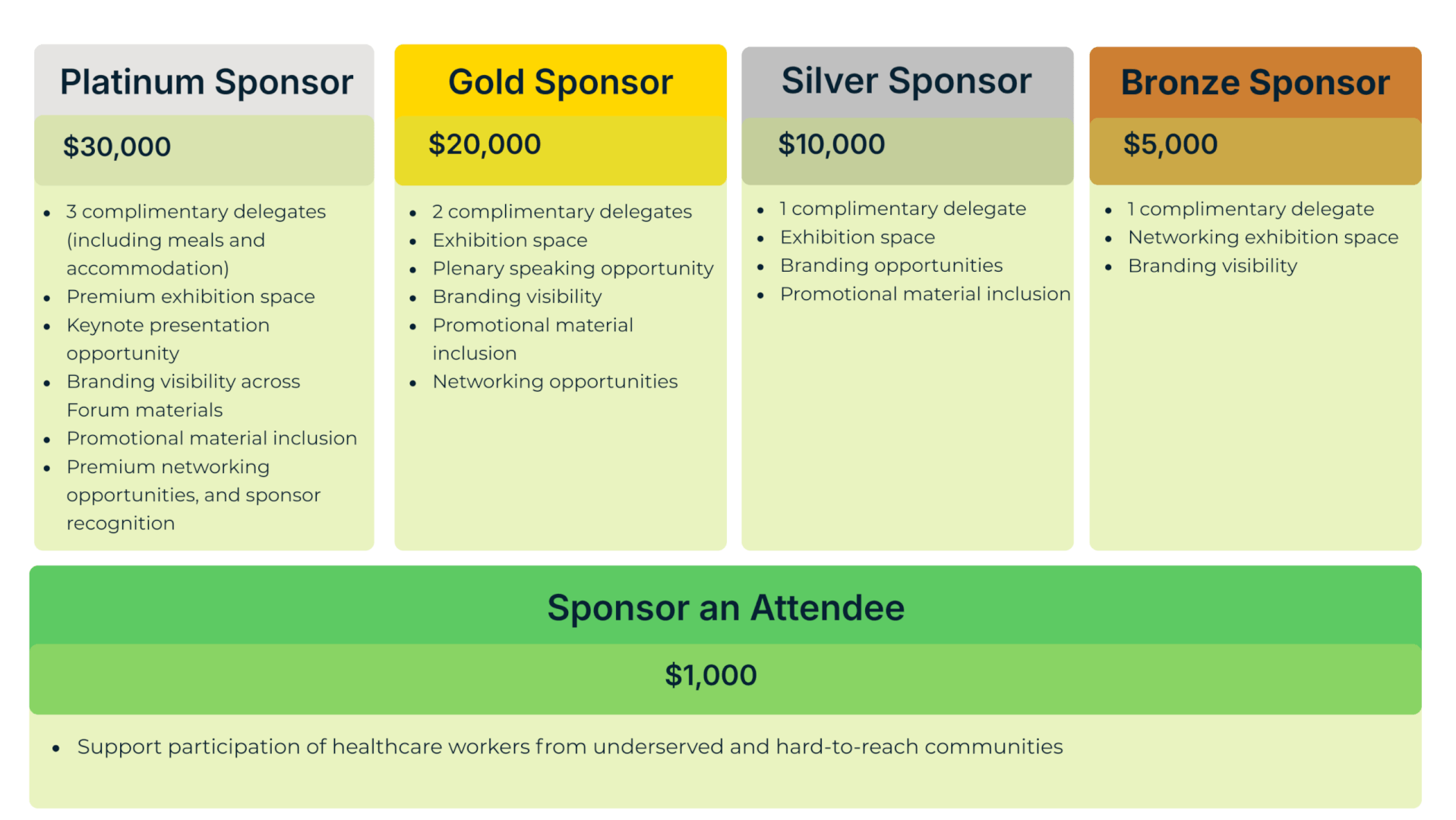
Sponsorship Packages
Customized Partnership Opportunities
We recognize that every organization has unique priorities and objectives. Customized sponsorship and partnership packages can be developed to align with your strategic interests, visibility goals, and engagement preferences.
Become a Partner: Join us in making the 10th EPN Biennial Forum a transformative platform for collaboration, innovation, and action towards sustainable and resilient health systems for last-mile access in Africa.
Forum Dates: 5–9 October 2026 Location: Lusaka, Zambia