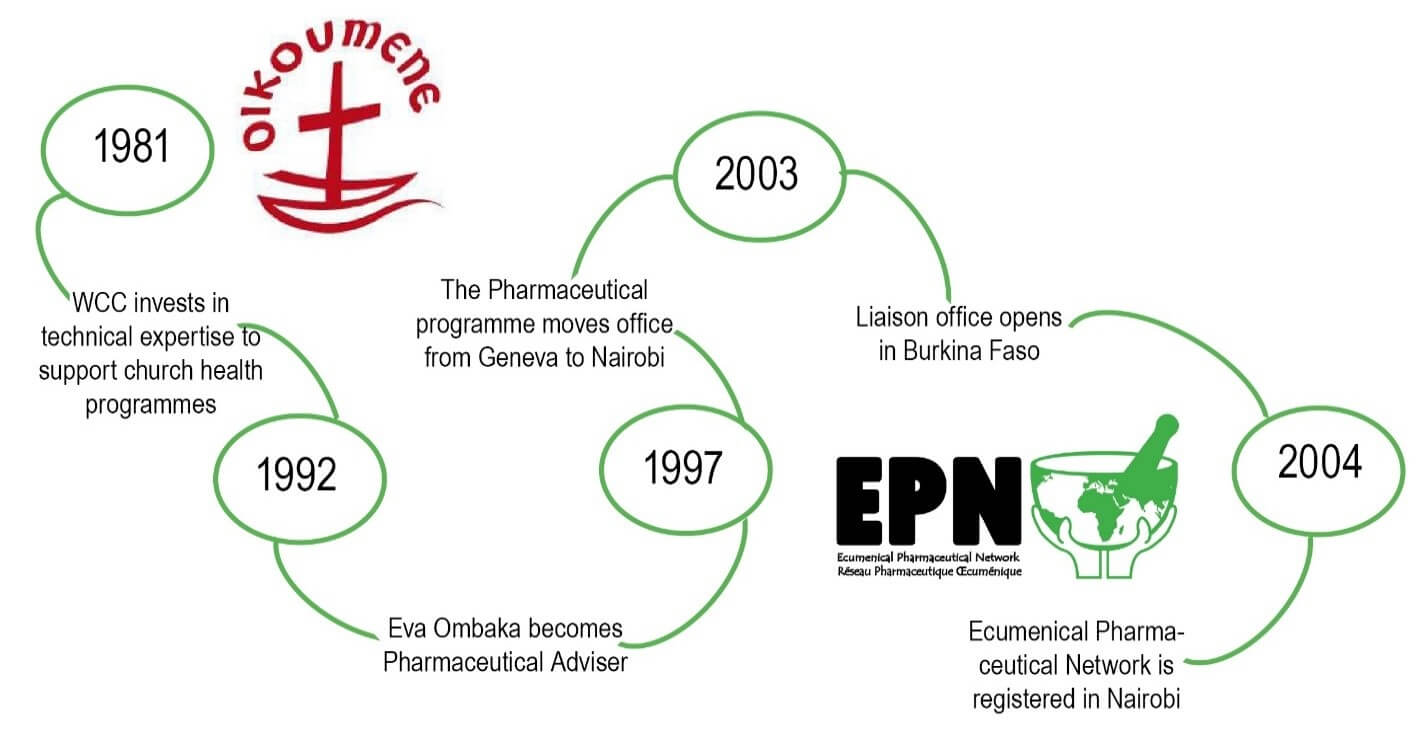
In 1981, the Christian Medical Commission (CMC) of the World Council of Churches (WCC) assigned a pharmaceutical adviser to provide technical support in the area of pharmaceutical technical support to church health programmes in Africa. Later in 2000, the supported church health organizations jointly agreed to become a Network through membership. The Ecumenical Pharmaceutical Network (EPN) was then registered as a non-profit organization with a secretariat based in Nairobi, Kenya. EPN celebrates its 40th anniversary in 2021.
From the mid-1960s, the World Council of Churches (WCC) has worked intensively on issues of health, building on the experience of the health work of mission societies and churches. It had a central role in promoting the concept of primary health care, was in close contact with WHO and contributed much to the Alma Ata declaration on primary health care in 1978.[1] The need to look more closely into medicines became clearer over time. It was first discussed at the Annual General Meeting of the Christian Medical Commission (CMC) in 1980. Main issues were the services of church-related procurement agencies in developed countries and the establishment of pharmaceutical distribution services in developing countries. In 1981 at a consultation the Pharmaceutical Advisory Group (PAG) was formed which was the beginning of what is now EPN and in 1982 the WCC employed a consultant for its pharmaceutical programme.
In the initial years (1982-85), information was gathered on the pharmaceutical situation in nine countries and the development of drug distribution systems encouraged. From 1987, when an advisor was based in Geneva, more emphasis was put on advocacy and networking. In 1992, an EPN coordinator was employed as a consultant. From 1992 on, a strong advocacy element was established in work with consumers in developing countries, in particular with regard to the Essential Medicines Concept and Rational Use of Medicines, strengthening local agencies in pharmaceutical management. The focus of networking turned more to the Global South. During this period, staff in CMC was reduced and the need was felt to make the pharmaceutical programme more attractive to funding partners.
In 1997, the programme was moved to Nairobi. A training programme of pharmaceutical assistants (PAT) to serve the three East African countries, was started in 1995 and continued until 2004. In the late 1990s increased efforts were made to include francophone African countries in the work. The PAG has since been turned into the EPN Forum, now meeting every two years. For the first time, the PAG meeting was held outside Geneva in Moshi, Tanzania, in October 2004.

In the early 2000s, EPN began to turn itself from a WCC linked programme to a network of members, trying to strengthen the role of members in EPN. In 2003, EPN and WHO did a participatory study of Drug Supply Organizations (WHO/EPN 2004). In 2004, a Strategic Plan (2004-6, extended to 2009) was developed, followed by subsequent Strategic Plans over the years (2010-15, 2016-2020 and currently 2021-2025).
EPN has diverse membership. Categories of members are full members (Christian Health Associations; Christian Secretariats, Church-related pharmaceutical agencies, church health institutions, church-related donor agencies and church-related health care providers) and associate members (any individual, institution or organization interested in promoting the objects of the Organization).
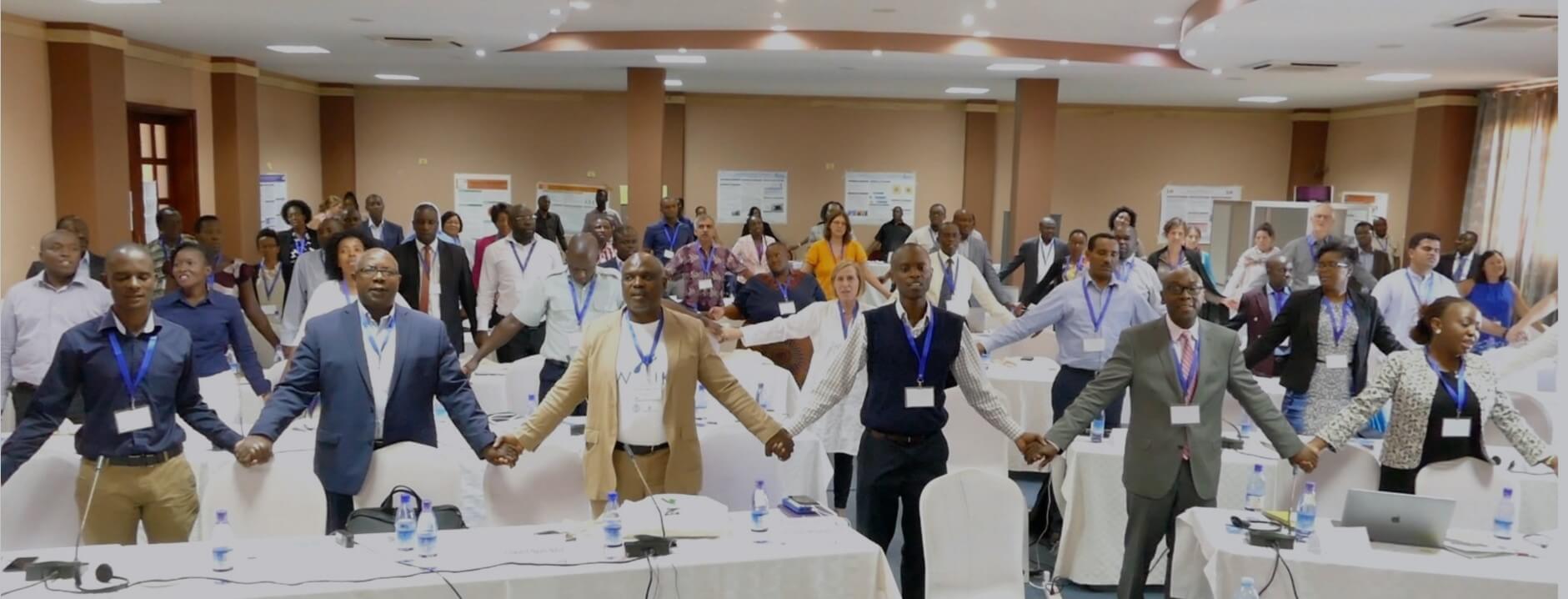
Currently EPN has 149 members with 25 Health System Strengthening Organizations, 35 Christian Health Associations, 19 Church Health Institutions, 19 Drug Supply Organizations and 51 Individuals.
[1] The chapter on history relies much on Raditapole et al. 1991, Asante et al. 1994, Asante 1998 and Nickson, EPN evaluation, 1999.
