The EPN’s Strategic Plan 2026–2030 advances Stronger Pharmaceutical Systems and Equitable Access to Quality Health Products. It sets out EPN’s strategic direction for strengthening faith-based health systems, advancing innovation and improving equitable access to quality pharmaceutical services.
EPN has launched its Strategic Plan 2026–2030, setting a renewed direction for the Network’s work to connect and strengthen faith-based health systems and advance equitable access to quality health products and pharmaceutical services.
Building on its experience and contributions to pharmaceutical systems strengthening across Africa and beyond, the new strategy provides a roadmap for consolidating progress, addressing persistent challenges and responding to emerging developments in the global health landscape.
Guided by its vision of “A leading faith-based network transforming lives through innovation and equitable access to pharmaceutical services for all,” EPN seeks to strengthen its role as a connector, catalyst and capacity builder for faith-based health institutions. The strategy reinforces the importance of collective action, innovation, evidence-informed interventions and strategic partnerships in advancing sustainable and equitable access to quality pharmaceutical services.
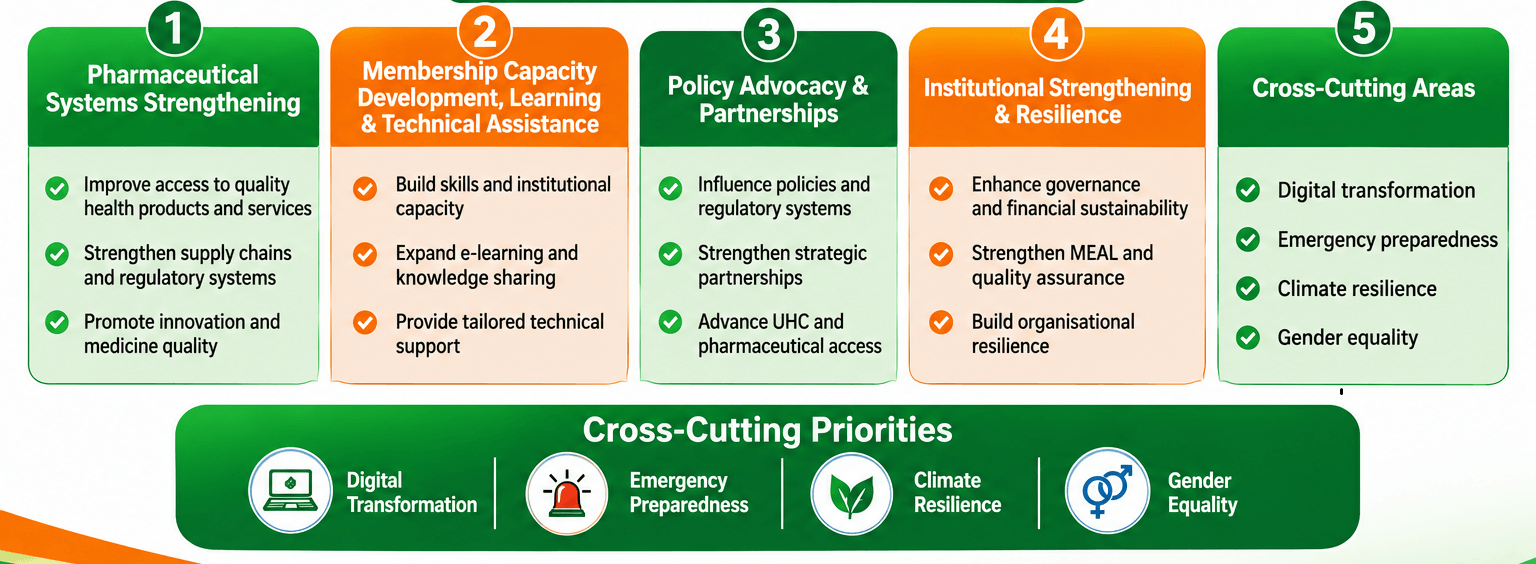
Five strategic pillars guiding EPN’s work
The Strategic Plan is anchored in five strategic pillars that will guide EPN’s programmes, institutional priorities and engagement with members and partners over the 2026–2030 period.
1. Pharmaceutical Systems Strengthening
EPN will strengthen pharmaceutical systems and improve access to quality health products, technologies and services. Key areas include access and service delivery, quality assurance, surveillance and regulatory systems, and strengthening products and supply chains through innovation. The Network will also promote initiatives addressing medicine quality, antimicrobial resistance, rational medicine use, local pharmaceutical manufacturing and resilient supply chains.
2. Capacity Development, Learning and Technical Assistance
Recognizing the expertise and potential of its network of more than 150 member institutions across 38 countries, EPN will strengthen the capacities of healthcare workers, managers, leaders and institutions. Priorities include expanding digital learning through the EPN Learning Management System (LMS), developing professional training programmes, promoting Communities of Practice, facilitating peer-to-peer learning and South-to-South collaboration, and providing tailored technical assistance and institutional support.
3. Policy Advocacy and Partnerships
EPN will strengthen its leadership and amplify the collective voice of its members to influence pharmaceutical policies, regulatory systems and health priorities at national, regional and global levels. Through strategic partnerships and evidence-informed advocacy, the Network will advance dialogue and coordinated action on priorities such as Universal Health Coverage, antimicrobial resistance, local pharmaceutical manufacturing, regulatory harmonization and sustainable pharmaceutical financing.
4. Institutional Strengthening and Resilience
Recognizing the importance of strong organizational systems in delivering sustainable impact, EPN will invest in governance, leadership, human resource capacity, financial sustainability, strategic communication and monitoring, evaluation, learning and quality assurance. These efforts will strengthen the Network’s accountability, operational effectiveness and ability to adapt to an evolving operating environment.
5. Cross-Cutting Areas
The strategy identifies digital transformation, emergency preparedness, climate resilience and gender equality as essential priorities that will be integrated across all strategic pillars. These areas will support more inclusive, responsive and resilient pharmaceutical systems while strengthening institutional capacity and sustainable health outcomes.
Addressing priority health challenges through collective action
Across its strategic pillars, EPN will continue to prioritize health areas where stronger pharmaceutical systems and equitable access to quality health products are essential. These include reproductive, maternal, newborn, child and adolescent health; non-communicable diseases; communicable diseases, including HIV/AIDS, tuberculosis, malaria and viral hepatitis; antimicrobial resistance, infection prevention and control, and health security; and neglected tropical diseases.
The strategy also recognizes the important role of faith-based health institutions and community structures in delivering accessible, quality health services, particularly to underserved populations. By leveraging its membership network, technical expertise and partnerships, EPN will continue to promote practical, context-responsive solutions that strengthen service delivery and improve health outcomes.
Working together towards sustainable impact
The implementation of the Strategic Plan will be driven through collaboration with EPN members, faith-based organizations, governments, regional and global institutions, development partners, academia and private-sector stakeholders.
EPN’s approach will emphasize member engagement, knowledge exchange, innovation, strategic partnerships and evidence-informed decision-making. By strengthening institutional capacities and mobilizing collective expertise and resources, the Network aims to enhance the contribution of faith-based health systems to stronger pharmaceutical systems and equitable access to quality health products and services.
The 2026–2030 Strategic Plan represents a shared direction for EPN and its network as it builds on its achievements, embraces emerging opportunities and works towards sustainable impact.
Together, we are advancing stronger pharmaceutical systems and equitable access to quality health products and services for all.
Read the EPN Strategic Plan 2026–2030: https://www.epnetwork.org/publications/strategic-plan-2026-2030.